





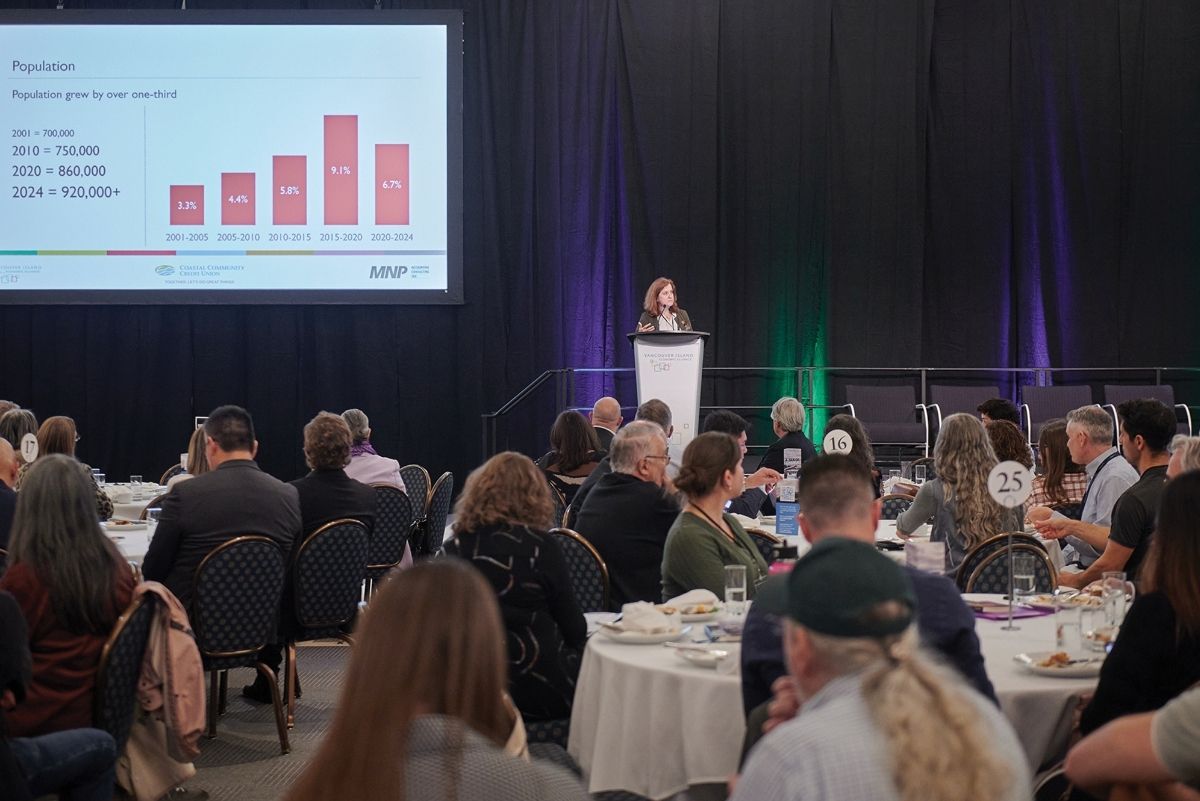
Vancouver Island’s economic resilience won’t come from any single sector or city, but will depend on the Island acting as an ecosystem. That message carried through the 19th annual Vancouver Island Economic Alliance (VIEA) State of the Island Summit held in Nanaimo, where more than 600 delegates from business, government, First Nations, education and non-profits gathered to chart a shared vision for 2050.
Susan Mowbray, partner of economics and research at MNP LLP, returned to deliver the annual “State of the Island” report highlighting both progress and pressure points.
She reported that Vancouver Island has increased by 250,000 residents in 25 years – nearly 60 per cent in the last decade – but 17 per cent of residents are now over the age of 70. Mowbray noted that this growth masks a deeper challenge: We are growing older, not necessarily stronger. With fewer working-age residents, the labour force is tightening, productivity is slowing and the economy is leaning more heavily on public spending and population-driven growth rather than private investment and innovation.
Slowing Growth
She said that for every new private sector job on the Island, two public sector jobs have been added, and economic growth has slowed to one to 1.5 per cent since pre-pandemic (which was two to 3.5 per cent). Mowbray cautioned that this leaves the region too reliant on the public sector and raises long-term sustainability concerns. The province’s reliance on population growth, housing construction and public investment rather than private-sector productivity has created a fragile foundation.
“We’re starting to see the government move on to things that are within their control. We’re seeing efforts made to diversify our trading relationships. We’re seeing interprovincial trade barriers come down. But these changes are going to take time,” said Mowbray, highlighting that what made us great in the past is now over. “We need to be thinking about where we want to be, not where we were.”
She said that while exports have not yet declined, early stockpiling ahead of tariff threats earlier this year masked underlying vulnerabilities.
“It’s not just governments that need to do things differently,” she said. “Businesses need to change how they are operating as well.” Mowbray stressed the need for investment in productivity, training for youth and innovation.
As the Island looks ahead to 2050, Mowbray reminded delegates that the issues of infrastructure, housing and demographics have been on the table for decades, but the opportunity now lies in tackling them together across communities and sectors to build the Island’s next economic chapter.