










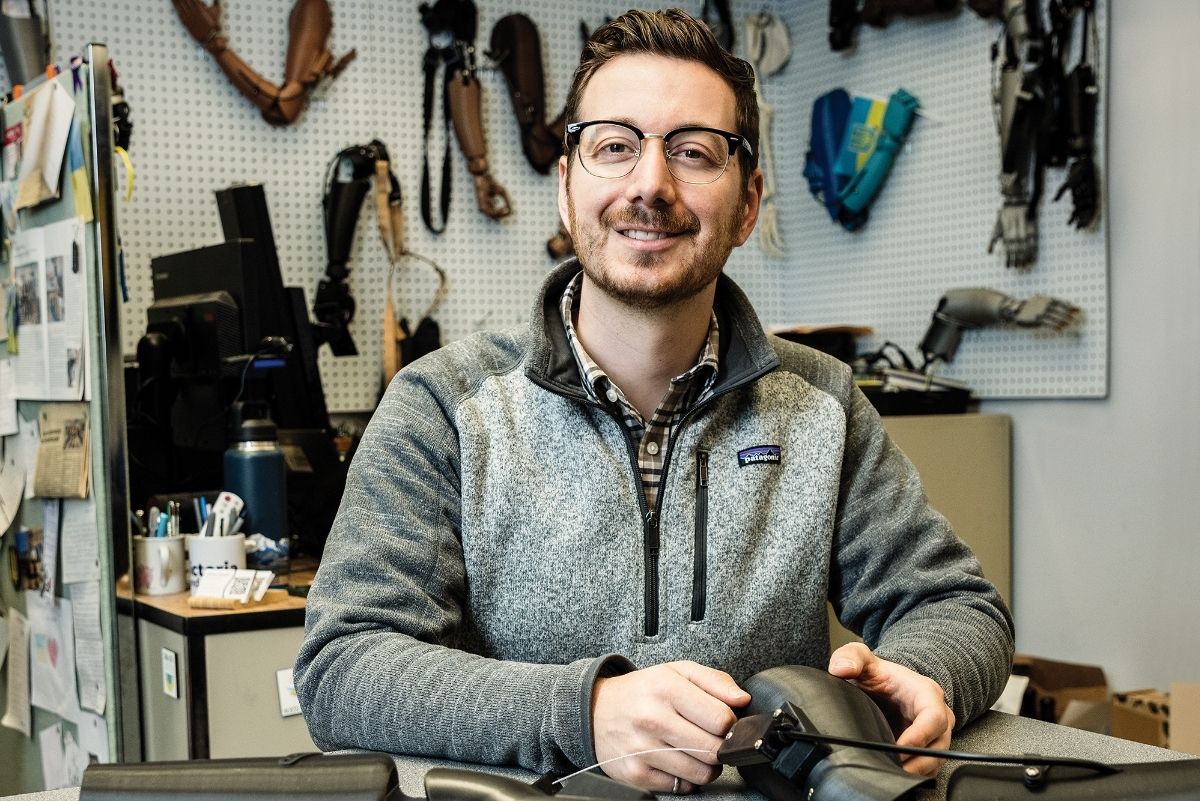
The Victoria Hand Project, a registered Canadian charity, has spent a decade developing quality upper-limb prosthetics for those with limited to non-existent access to prosthetic care. The project uses 3D-printing technology to speed up the manufacturing process while allowing for broken and/or outgrown prosthetic components to be reprinted and replaced with minimal fuss.
One of the project’s most recent campaigns saw several team members travel to Nepal in October. The six-day trip, supported by seven local Rotary Clubs, was to assist Limb Care Nepal with much-needed improvements including new equipment, software upgrades and clinician training.
“We haven’t been back to Nepal since 2019 and a lot has changed,” says Victoria Hand Project CEO Michael Peirone. “There’s only so much we can do online.”
The project develops prosthetics, then partners with organizations internationally to provide training, funding and equipment so the prosthetics can be manufactured and provided in the regions where they are needed. This approach allows prosthetic-care professionals to support their own communities. “When they continue to produce the prosthetic arms, they have the latest technology, the latest skills and everything like that,” says Peirone.
The project’s largest campaign is Hands for Ukraine, which has helped more than 140 Ukrainians since its launch in June 2023.
“We’re actually trialing a new model of the prosthetic elbow in Ukraine,” says Peirone, noting that above-elbow amputations are particularly prevalent in the region wracked by war. “Above-elbow prosthetic arms are more expensive, harder to make. So many people, even soldiers who lost their arm defending the country, are waiting — we’ve heard six months, 12 months.”
The 3D-printing process cuts the manufacturing time down to a few short days. The new elbow model provides improved functionality, broadening the range of use to improve patients’ quality of life.
Victoria Hand Project’s humanitarian work earned the charity the 2025 VIATEC Social Impact Award, and has emboldened team members to continue supporting amputees in need. While the project mostly focuses on providing international aid in areas lacking prosthetic-care funding, the team also works with Victoria locals to test new upper-limb prosthetics and features. According to Peirone, partial hand prosthetics are particularly in demand in Canada.
“That, surprisingly, isn’t typically covered [by insurance providers] in Canada,” says Peirone. Such prosthetics can cost patients thousands of dollars out of pocket. “We have a solution that can cost $100 or a few hundred [dollars]. We want to, hopefully, begin providing that to Canadians through their care providers in the future.”