










This year marked a post-COVID apex of challenges. With downtown businesses threatening to decamp as street encampments increasingly spread, with the traffic cauldron bubbling amid bike lanes, bus lanes, no lanes and congestion threatening to overflow, and with continued pressure surrounding trade with the U.S., Victorians seemingly got little relief from local and global pressures.
Everyone knows the issues. Now decision makers are being pushed to act.
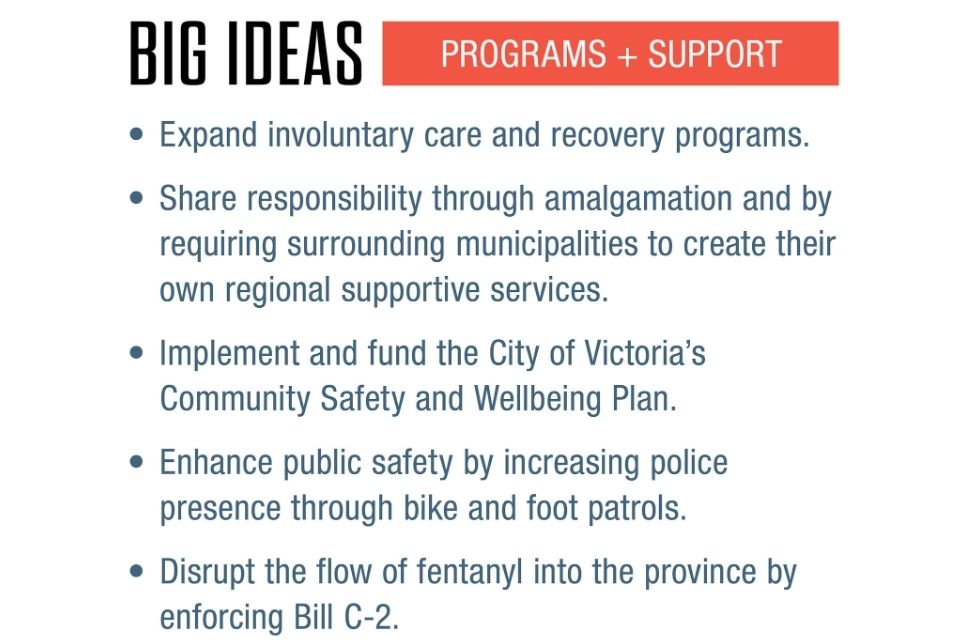
With strategies in development, 2026 will be a year of tests for Victoria. Will the new Community Safety and Wellbeing Plan reduce crime and drug use and elevate safety? Will the federal government release idle lands for housing? Will the province allocate more money for transit and perhaps a ferry link between Colwood and downtown Victoria?
Let’s examine three relevant threads that warrant attention: downtown safety, drug use, crime and street disorder; infrastructure and transportation; and housing, affordability and the cost of living in the region.

When homelessness, drug use and street crime are discussed, viewpoints are diverse. There’s the business perspective, which is concerned with staying afloat, and there are the politicians’ positions, which tread the ever-shifting waters of pleasing voters. Caught in the middle are police.
City Under Strain
In August, Fiona Wilson replaced Del Manak as Victoria/Esquimalt’s new police chief, arriving in the Garden City after 27 years with the Vancouver Police Department, most recently as deputy chief.
“Victoria is almost a small sample of Vancouver,” says Wilson. Not only do the two cities share a robust, summer tourism environment, they share the very apparent population of unhoused individuals and a similar drug scene where fentanyl reigns as the biggest issue. “Fentanyl is a wicked, wicked drug,” Wilson says, referring to the manic hold the drug has on users layered on top of mental health afflictions that lead to repeated hospital emergency department visits.
Shared Responsibility
Victoria Mayor Marianne Alto shares the frustration. “You can be sure this council has had enough,” she says of Victoria being the centre of Greater Victoria’s homeless/addiction/crime triple threat. “It’s been years in the making. We have years of work ahead of us.”
What rankles Alto is that surrounding municipalities have not been doing their part to address the problems. Accordingly, Alto supports amalgamation, which means sharing the burdens currently on Victoria’s shoulders. She envisions three, not 13, municipalities: Core, Peninsula and Westside.
“Victoria has carried the load for a long time,” Alto says, referring to Sidney’s refusal to open an overnight shelter and Saanich’s delayed temporary overnight shelter decision. “We need to have other municipalities step up.”
A New Plan
The City of Victoria began to look at the crime, drug use and disorder problem in 2023, but by the summer of 2025 creating a plan became the city’s biggest priority. The urgency was in response to the Downtown Victoria Business Association’s annual report which revealed that 48 per cent of downtown businesses would consider closing if their lease expired in the next 12 months.
The city intends to spend more than $10 million over several years on its Community Safety and Wellbeing Plan (CSWB) to address disorder downtown. “We want to interrupt behaviours that have become commonplace, but we want to make sure we’re not adding money to the city’s budget,” Alto says.
The plan will take into account the business community’s concerns, but Alto says it will also provide a template for how Victoria will evolve. “There is a role for police, many roles for bylaws, but also roles for public works,” she says.
Key highlights include adding police and bylaw officers, expanding cleanup and rehabilitation efforts, establishing more short-term shelter options and improving support and transport for unhoused residents.
“We are very committed to dealing with the issues now, but we cannot sustain this over the long run,” Alto says. The city has been funding programs and services usually financed by the provincial government. Funding for the multi-faceted plan will be taken from existing programs and projects such as upgrades to Royal Athletic Park and the renewal of Centennial Square.
Breaking Point
The CEO of the Greater Victoria Chamber of Commerce says all levels of government have been aware of drug- and homeless-related problems for years, yet they have ignored policy changes. “We need a legal system that works, not catch and release,” says John Wilson. He believes the government is too lenient, pointing to roughly 30 highly active offenders in Victoria. Multiple business leaders agree that the legal system must better support police and enforce consequences for repeat offenders.
“Judges have become social workers,” says Gerald Hartwig, CEO of Hartwig Industries, adding that the judiciary needs to get tougher on criminals. “A bad upbringing used to be a reason to succeed. Now it’s an excuse to fail,” he says. He also believes organizations providing social services to the street population must ensure they clean up sites where they operate.
“Make social providers follow the same rules as businesses and society,” Hartwig says.
Provincial Programs and Police Support
Nina Krieger says she shares the concerns of business owners and police regarding crime, but there’s no silver bullet. As minister of public safety and solicitor general, Krieger says the root causes of crime continue to be a significant concern for her government. The MLA for Victoria-Swan Lake says poverty, mental health issues and addictions are driving crime, not solely in Victoria, but across North America.
At the Union of B.C. Municipalities’ annual convention in September in Victoria, multiple resolutions were brought forward by B.C. mayors and councillors in relation to homelessness and public safety.
Krieger points to programs like the Road to Recovery model and New Roads Therapeutic Recovery Community as programs to address mental health and addiction. There is also ongoing development of involuntary care programs. She also references the Special Investigation and Targeted Enforcement (SITE) program, which monitors repeat offenders. Victoria police have received over $500,000 since SITE’s launch in 2023. In September, Krieger said 44 individuals were being monitored in Victoria.
Former police chief Manak offers a parting perspective. “We need to be soft on our vulnerable, marginalized street population and we need to be hard on the criminals who are exploiting the marginalized for profit,” he says. Moreover, involuntary care should be ramped up. “It’s naive when we continue to ignore the problem. It’s inhumane to let someone suffer on the street.” But Manak warns that recovery programs lead people “right back into supportive housing where there are active drug users,” and he calls for more dry housing or restricted housing. “There’s an overreliance on harm reduction.”
Read Part Two: Infrastructure and Transportation.
Read Part Three: Housing and Affordability.