


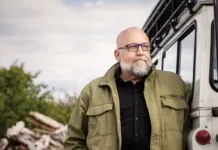



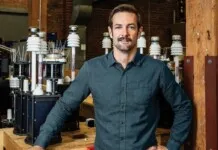

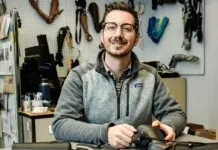

Surfing and waves. Scott Beatty has made his passion for both his life’s work.
Growing up on the endlessly wide beaches of Parksville-Qualicum, the ocean was both teacher and mystery. Enough to make him begin asking the questions that would eventually lead to studies in mechanical engineering at UBC and both a masters degree and PhD from UVic, working on ocean wave energy.
A “born tinkerer,” he was always taking things apart and creating his own little machines, fascinated with motors, rockets, aircraft and radio-control cars.
“All that stuff. I couldn’t get enough of it. I’d always had this, ‘you might be an engineer one day’ voice from my parents, family friends, and that story just kept on building.”
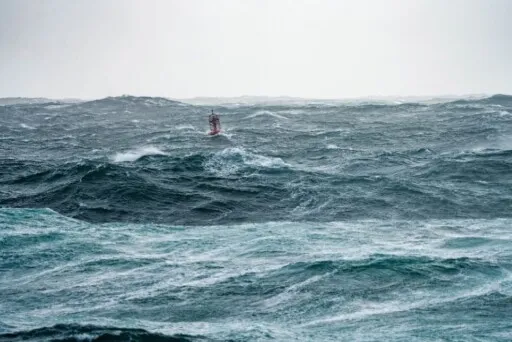
The now 45-year-old founded Victoria’s MarineLabs in 2017, creating tech that produces real-time and predictive coastal intelligence — necessary information for shipping, for ports and for monitoring climate change — via a floating sensor network providing a machine learning-based forecast that’s super accurate and immediate.
With 30 staff, MarineLabs, and its CoastAware technology, are already surfing their own big swell of opportunity.
Douglas: You once said MarineLabs is like Google Maps for ports and marine pilots. How does that work?
Beatty: I described it that way to try to explain the paradigm shift in the before and after of having this technology. Think of driving through a foreign city in 1990. You don’t have Google Maps, you might have a map book that you’ve studied … and you’re going through roundabouts and you’re on the wrong side of the road. With MarineLabs CoastAware [subscription service], we’re putting data along the approaches to ports where they’ve never had it before and giving them forecasting that’s a lot more accurate than they’ve ever had.
Douglas: MarineLabs clients include tugboat operators, ferry services, coastal engineering projects and the ports themselves. They also include marine pilots — why is that significant?
Beatty: Every ship that comes into ports in the developed world requires a pilot who knows the local waters and currents and waves to bring it in. So they use our weather data for all of the times they have to climb on rope ladders up a ship and navigate a ship.
Douglas: A $4.5-million investment in seed money came in Year 7 of the company. Another $4 million arrived in the fall of 2025. You’ve said that equity investments are challenging for companies in Victoria with hardware as part of the package. How have you made it work?
Beatty: Most companies raise a seed in Year 1 and 2, but we were able to bootstrap through a combination of sales and grants to get to where we were. At that point we realized that this is a much larger business that has a higher impact so we’re going to raise money. I was actively raising money, and we were able to raise $8.5 million of equity financing, but alongside that we’ve had over $10 million of grant funding to date and an equal amount of sales. We see sales as the predominant way of funding our ambitions moving forward.
Douglas: In 2022 you had deployed 26 sensor buoys. How many are out there now?
Beatty: This year we have about 65 and they are located from Prince Rupert down the B.C. coast, Halifax and Saint John. We’re in the Texas Gulf and we’re also in Oregon and California.
Douglas: You opted for a data subscription service rather than selling the tech itself. Why?
Beatty: Business model-wise, having recurring revenue is superior. The revenue offers all kinds of benefits in terms of being able to access capital for our company. But there’s other great reasons. If we own and operate [our tech] out on the ocean we can choose when it needs to be swapped or fixed or maintained. And we don’t have to worry about the warranty repair cycle or the selling volumes of widgets. We get to focus on quality. And for us the promise to the customer is the most reliable and accurate data.
Douglas: Why is the data so valuable?
Beatty: The harbourmaster of a port needs to make calls on whether ships can come in and out of the port every day. If the harbourmaster is looking at weather data that is incorrect and they make a call on a ship, the ship can arrive at the terminal and not be allowed to unload because the cranes won’t operate above, say, 25 or 30 knots wind.
Douglas: How do you inspire your team?
Beatty: I try to be as authentic as I can with everybody. If I’m feeling not so good about something, everyone can usually see it and I will talk about it and we’ll address things head on.
Douglas: Did you receive good mentorship?
Beatty: If you’re going to be an entrepreneur, the only way is to surround yourself with mentors.
One mentor that stands out is Josh McKenty, a very successful software developer based in Victoria now, but has been involved with all kinds of amazing projects in Silicon Valley and NASA. I crossed paths with him when I was finishing my PhD and I had this business idea for MarineLabs. He said, “You should do that. That’s exciting. Go for it.” And I needed that push. I probably wouldn’t have done this without that push.
Douglas: What’s the future look like for MarineLabs?
Beatty: By the next time you and I talk we’ll be operating on other continents, which is exciting. And we see a massive opportunity to get many, many of our sensor nodes out on coastlines. I would love to be able to tell you we’ll have thousands of units in the water by next year. I can’t commit to that. But we’re being that ambitious.